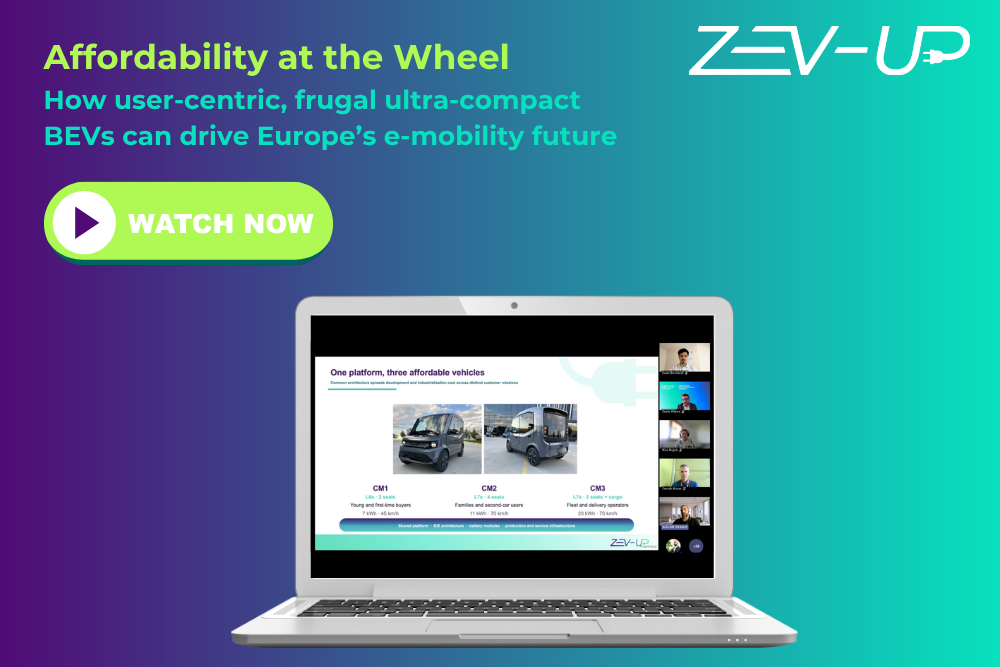
ZEV-UP has reached a major milestone with the completion of Deliverable D2.2 Vehicle Design, led by Beemobs with contributions from Ford Otosan, AKKODIS, Rhoé, Coşkunöz, Elaphe, and FEV Türkiye. The work marks the first full digital definition of the ZEV-UP vehicle family, comprising an ultra-compact two-seater for urban use, a four-seater for families, and a two-seater commercial vehicle with a cargo area. This important work lays the foundation for the project’s upcoming prototype building and testing phases.
At the heart of this achievement is the creation of a complete digital design package, validated through virtual analyses. All components across eight core system domains – including chassis, interior trim, exterior trim, Electric & Electronics (E/E) systems, underbody, Heater, Ventilation, Air Conditioner (HVAC), Body-in-White, e-powertrain – have been designed and integrated into a single complete digital structure. Partners also finalised the ZEV-UP modular platform. All three variants are now supported by one common platform, sharing major subsystems such as the body structure, seats, front doors, tailgate, in-wheel motors, gearboxes, and the swappable battery pack design.
The deliverable also confirms several important technical developments. A new rear trailing-arm suspension has been designed for the in-wheel motors, alongside custom components such as front springs, steering column, brake pedal, and routings. Simulation models were used to assess ride, handling, and comfort optimisation. The underbody structure has undergone extensive iterations to meet stiffness, crash, and manufacturability requirements, using aluminum structures with welded and cast elements.
The full interior and exterior trim components have been developed specifically for ZEV-UP, taking into account styling, manufacturability, cost, and regulatory constraints. Safety has been a central focus throughout the design process, with multiple virtual crash, durability, and structural simulations conducted for key systems, including seat anchorage, underbody crashworthiness, and full-vehicle crash models.
The full electrical and software systems have also been defined. The complete high- and low-voltage electrical architecture and power units were defined, including the charging system, solar panel integration, vehicle control units, infotainment, and communication networks.
A notable finding is the potential of additive manufacturing. The ZEV-UP partners found that 31% of interior components could be produced using this approach. Significant additive manufacturing redesigns included dashboard components, screen fascia, storage units, mirror covers, and wheel covers.
With the digital vehicle now fully defined, ZEV-UP enters a crucial new phase. The work completed in D2.2 through coordinated multi-partner design, virtual verification, and system-level optimisation, resulted in a complete and manufacturable set of components that will feed directly into the prototype building phase, and the upcoming performance, mileage, and homologation testing. This milestone ensures that the project moves forward with a solid and well-integrated vehicle design, ready to transition from digital definition to real-world validation.
Stay tuned as ZEV-UP unveils its vehicles in 2026! Follow ZEV-UP on LinkedIn for the latest updates.