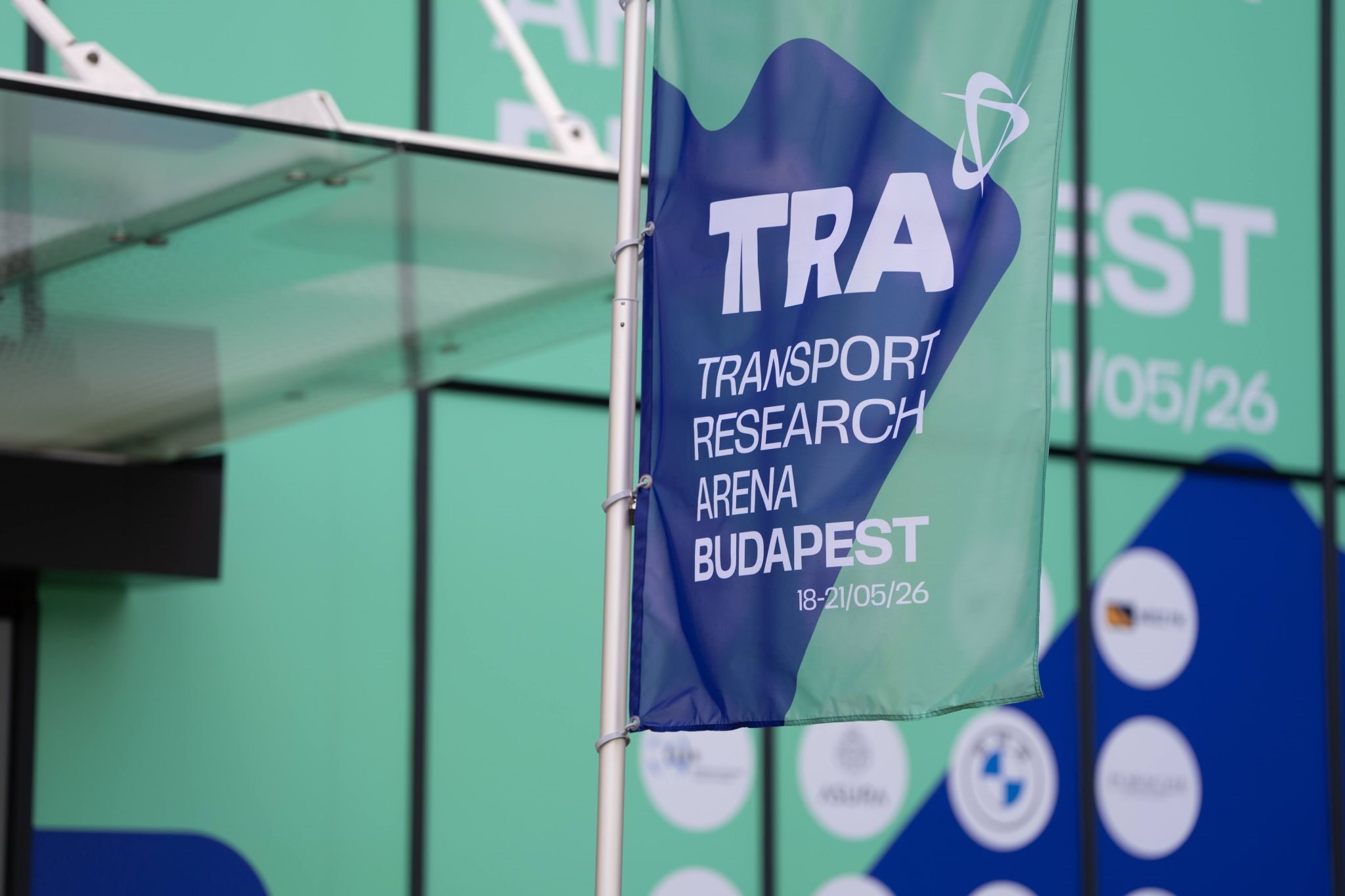
The Transport Research Arena (TRA) 2026 brought together more than 3,000 researchers, policymakers, and industry representatives in Budapest from 18 to 21 May 2026, under the theme “ReGeneration in transport”. One of Europe’s most prominent events on transport research and innovation, TRA 2026 provided a platform for exchanging knowledge on the most pressing challenges facing the sector today.
ZEV-UP was active throughout the conference, with representation at the ERTICO stand, where participants could learn more about the project, and three papers presentations.
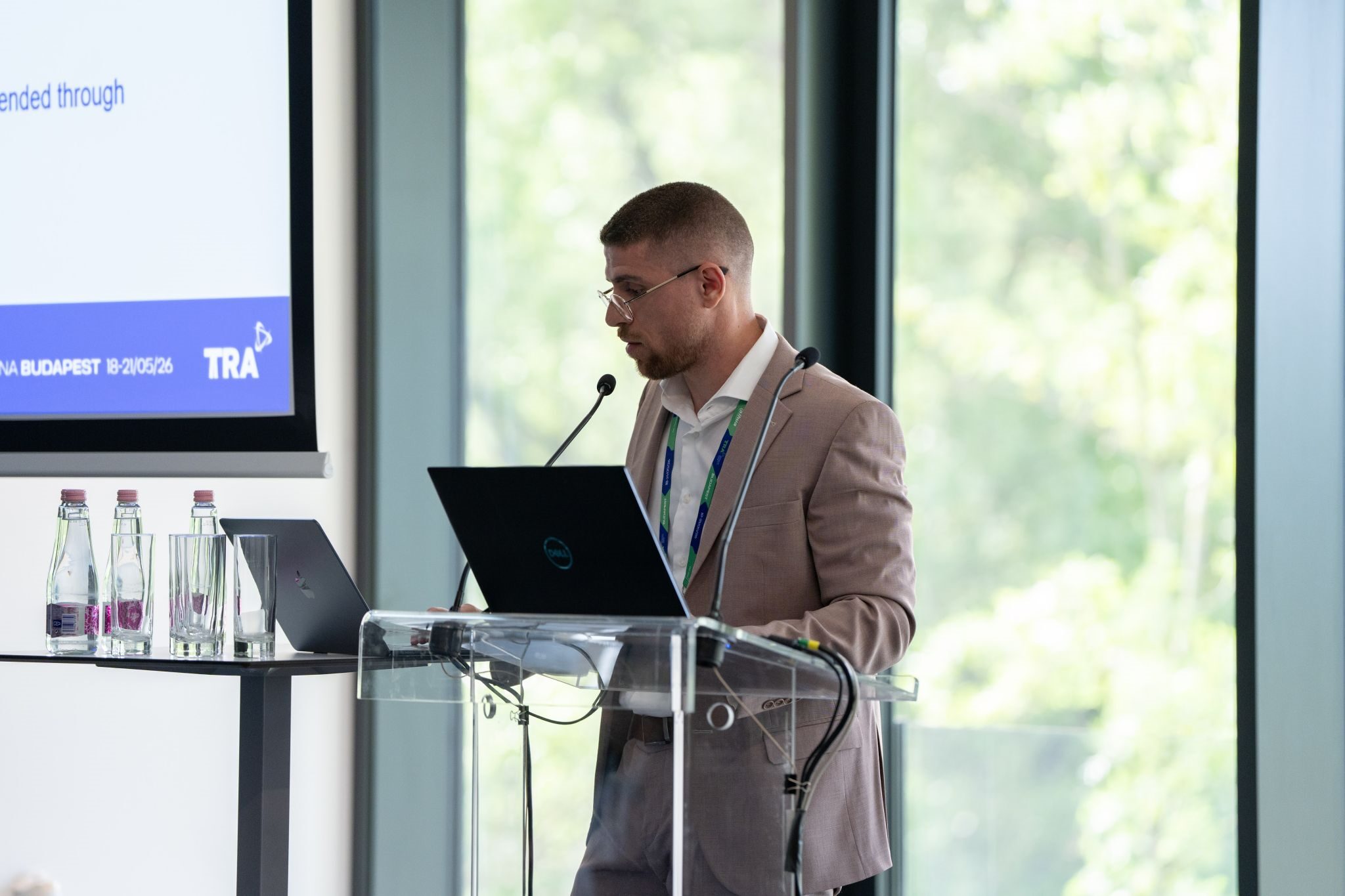
Presented by Yannis Kalenteridis (Rhoé) during Technical Session 1, “Electric Vehicle Adoption in Developing Economies: Literature Insights and Forecast for South Africa“, co-authored with Victoria Zorba, examines electric vehicle adoption in South Africa using the Simple Bass Model and Generalized Bass Model. It analyses how macroeconomic factors such as inflation, fuel price changes, and broader economic conditions influence the uptake of Battery Electric Vehicles and Hybrid Electric Vehicles. The findings suggest that higher-income consumers may view Battery Electric Vehicles as a safeguard against economic instability, while rising fuel prices mainly encourage Hybrid Electric Vehicle adoption among middle-income households seeking shorter-term cost savings. Overall, the study highlights the important role of economic conditions in shaping EV diffusion in South Africa.
“Urban EV Adoption Charging Infrastructure Readiness Level (ECIRL) Index: A Strategic Tool for Policymakers to Assess Public Charging Infrastructure“, co-authored by Victoria Zorba, Ilianna Hala, Konstandinos Grizos, Paulo Cantillano-Lizana, Giulia Renzi and Theocharis Vlachopanagiotis, was also presented as a poster by Yannis Kalenteridis. The paper focuses on the readiness of urban public AC Level 2 charging infrastructure to support electric vehicle adoption in European cities. It introduces a composite indicator, the Urban EV Adoption Charging Infrastructure Readiness Level, which assesses charging networks based on density, spatial distribution, and accessibility. The methodology was applied to Thessaloniki, Leeds, Oslo, Timişoara, Ljubljana, and Split, highlighting significant differences in infrastructure readiness. Oslo performed best overall, while Split and Timişoara showed the greatest need for improvement. The results can support cities in identifying specific infrastructure gaps and developing targeted policies for EV charging network planning.
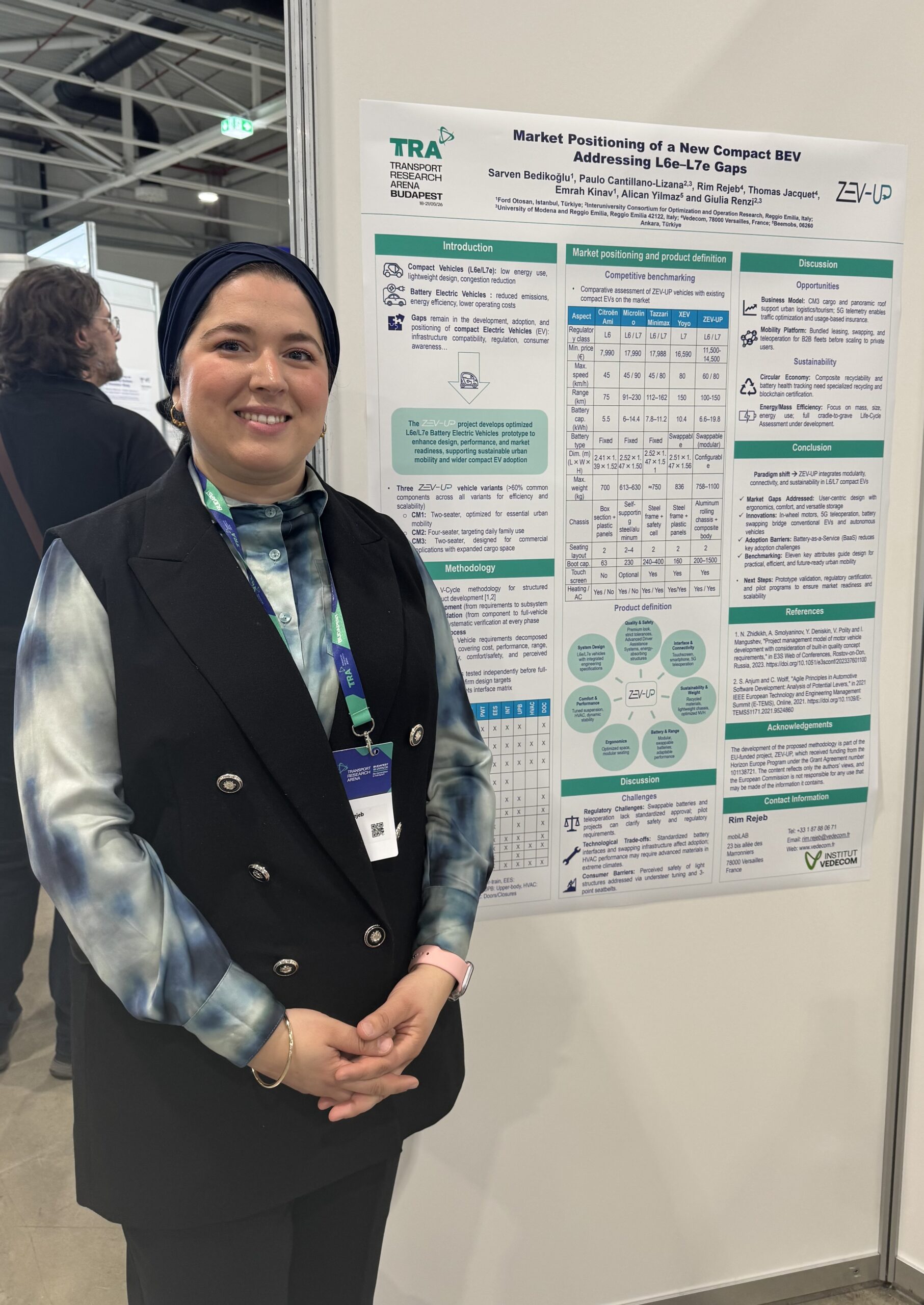
Rim Rejeb (VEDECOM) presented the poster “Market Positioning for a New Compact Battery Electric Vehicle: Addressing Market Gaps in L6e and L7e Segments“, co-authored with Sarven Bedikoğlu, Paulo Cantillano-Lizana, Thomas Jacquet, Emrah Kinav, Alican Yilmaz, and Giulia Renzi. The study analyses the positioning of the three ZEV-UP vehicle variants within the compact electric vehicle market and identifies several unmet user needs in the L6e/L7e segments. In particular, existing vehicles often require trade-offs between affordability, passenger and cargo capacity, comfort, connectivity, and driving range. The analysis also highlights limited flexibility for different use cases (personal, family, and commercial mobility) and a lack of advanced technological features in this market segment. The findings show that ZEV-UP addresses these gaps through a user-centred design combining affordability, enhanced ergonomics, and technological innovation. The vehicles offer improved ingress and egress comfort, spacious interiors, and significantly larger storage capacities compared to many competitors. Key innovations include a modular swappable battery system, allowing users to adapt vehicle range to their needs, and a 5G-enabled teleoperation system that supports remote operation, fleet management, and shared mobility services. Additional features such as advanced connectivity, smartphone integration, ADAS functionalities, and flexible vehicle configurations position ZEV-UP as a versatile and future-ready solution for sustainable urban mobility.
TRA 2026 proved a productive and valuable event for ZEV-UP. The papers presented attracted positive feedback from attendees who could identify the added value of ZEV-UP vehicles compared to similar compact electric vehicles. The conference brought together participants from a wide range of fields, including logistics, automation, connectivity, and shared mobility, making it a useful setting for exploring how ZEV-UP vehicles could meet the mobility needs of different types of users.