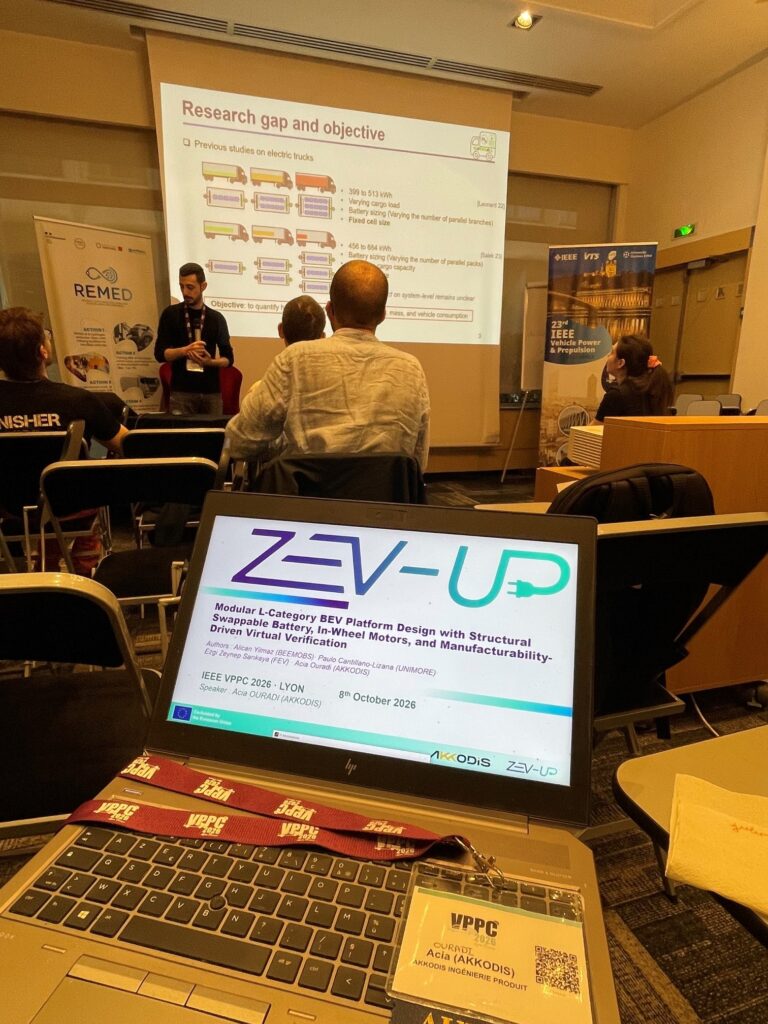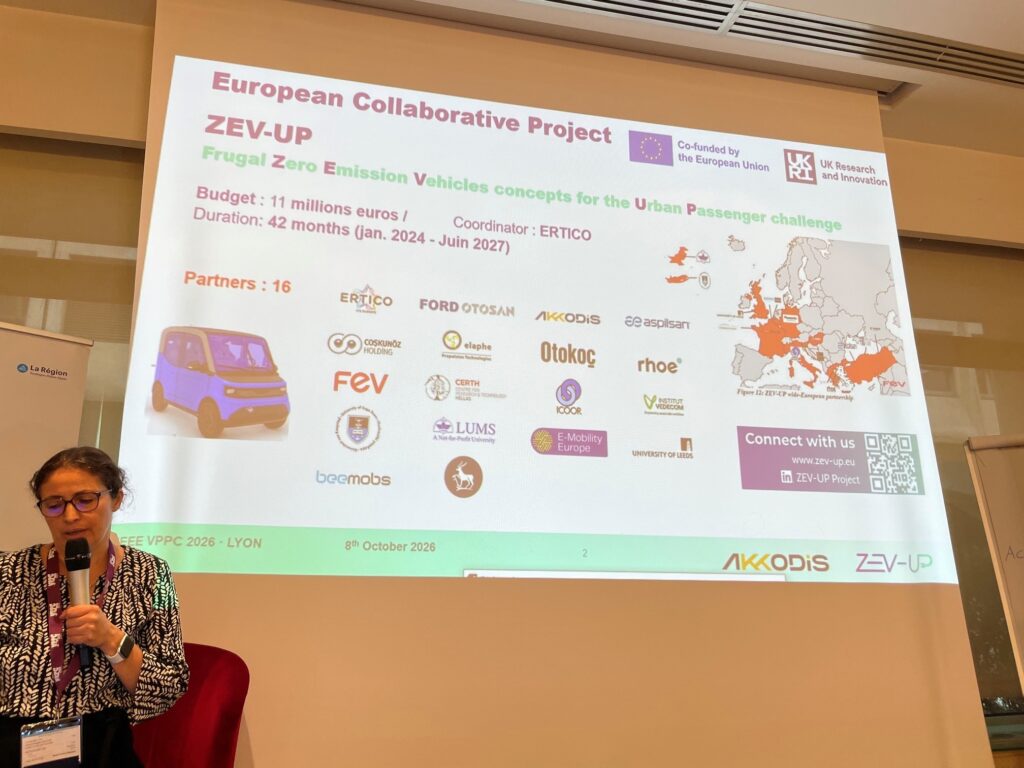
ZEV-UP took part in the 23rd IEEE Vehicle Power and Propulsion Conference (IEEE VPPC 2026), held from 5 to 9 October 2026 in Lyon, France. The conference brought together engineers, academia, and industry stakeholders to discuss the latest developments in electrified vehicle power and propulsion, and related technologies that support the decarbonisation of mobility. The event programme included keynote presentations, technical and tutorial sessions, poster presentations, special and invited sessions, as well as exhibitions.
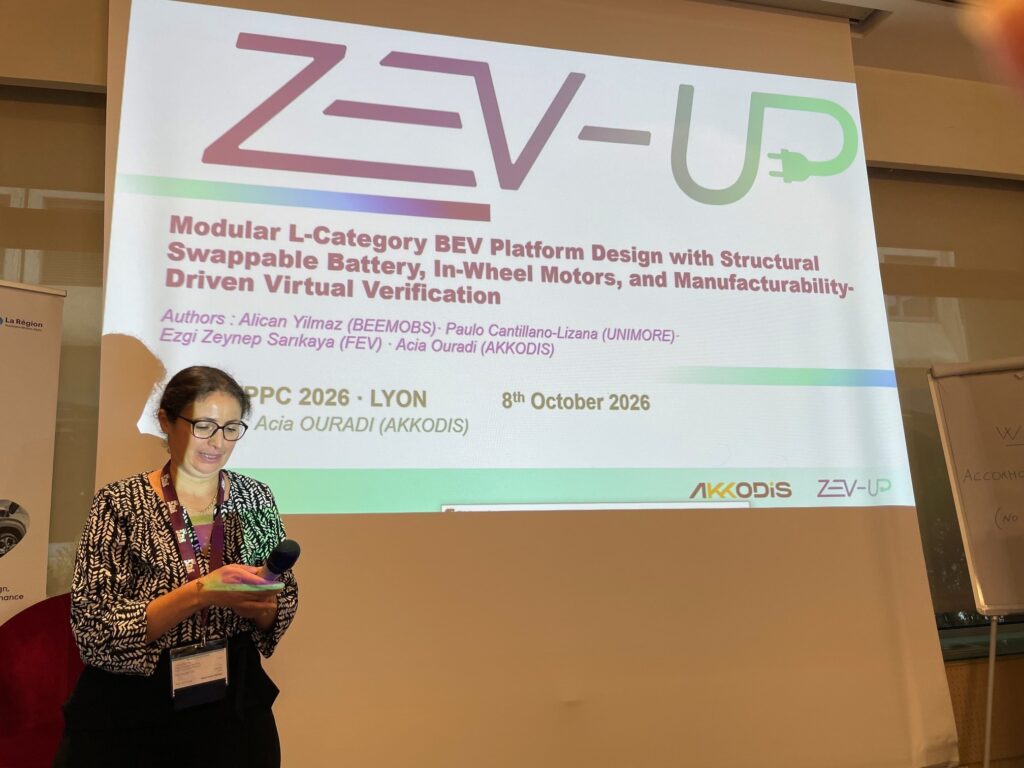
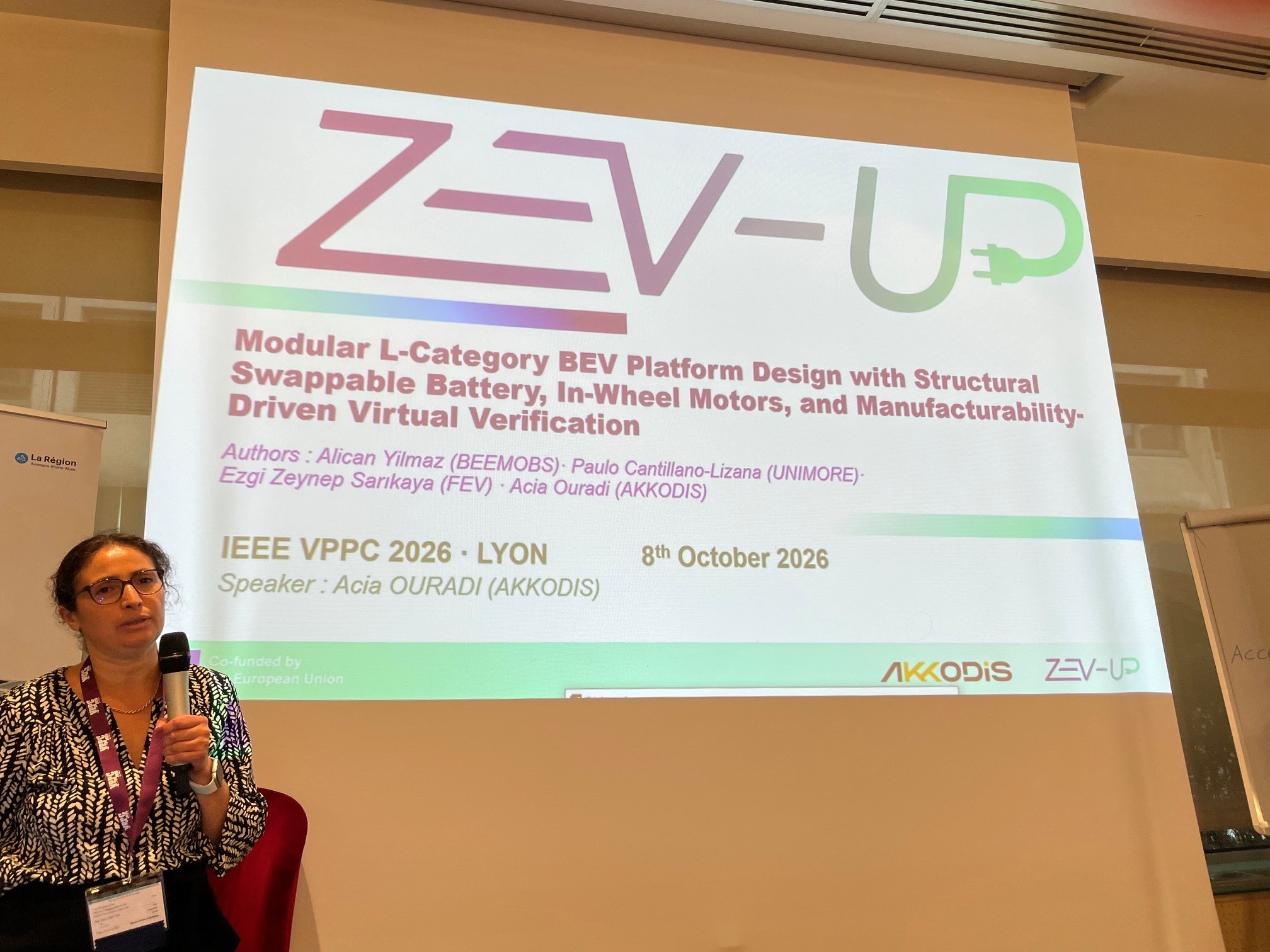
Acia Ouradi (AKKODIS) represented ZEV-UP in a session on “Scalability and Modularity for Electric Vehicles”. She presented the paper “Modular L-Category BEV Platform Design with Structural Swappable Battery, In-Wheel Motors, and Manufacturability-Driven Virtual Verification”, co-authored with Alican Yilmaz (Beemobs), Paulo Cantillano-Lizana (UNIMORE), and Ezgi Zeynep Sarıkaya (FEV).
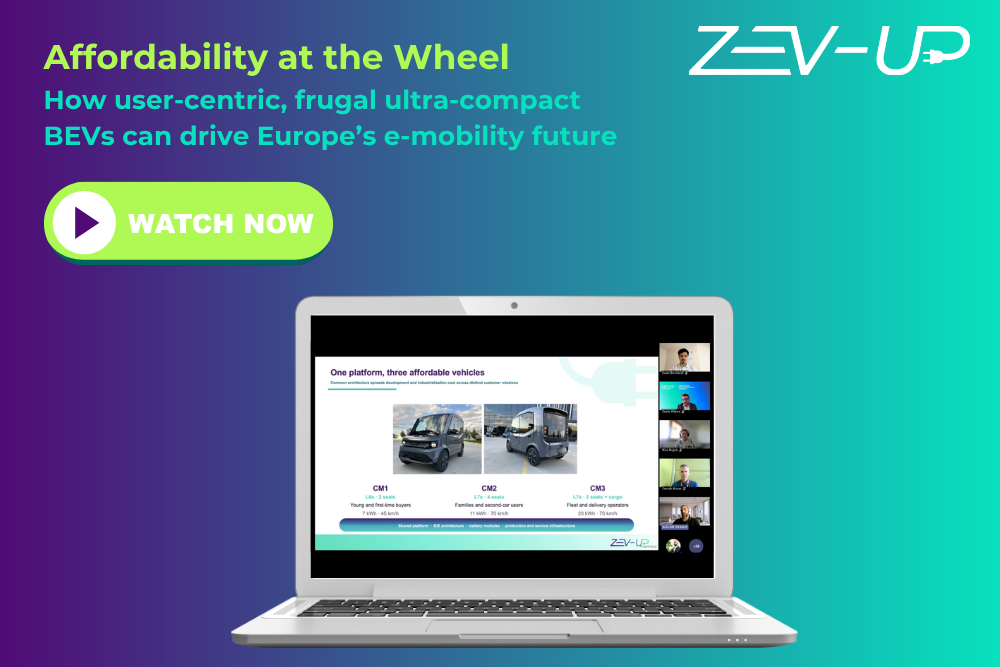
The paper presents the ZEV-UP modular battery-electric vehicle platform for lightweight L-category urban mobility. It develops three vehicle variants, from one shared structural platform, reducing tooling, engineering, and certification complexity. Variants are differentiated mainly through interior configuration, software-limited speed and power, and battery capacity, while retaining common hardware.
A key innovation is the structural swappable battery system. Three capacities, approximately 6.6, 12.2, and 20.7 kWh, use the same mechanical and electrical interfaces, enabling compatibility across all vehicle variants and supporting Battery-as-a-Service. Rear in-wheel motors provide independent torque control, while multibody dynamics and finite-element analysis virtually verify chassis behavior and safety-critical structures.
Manufacturability is evaluated using additive-manufacturing screening, topology optimisation, and Design for Additive Manufacturing. The optimised seat podium achieved approximately 41% mass reduction and met structural requirements. However, serial metal additive manufacturing was rejected because of cost and homologation concerns. Polymer components were successfully redesigned and manufactured using selective laser sintering for four prototypes, reducing vehicle weight and avoiding tooling development costs. Overall, the study demonstrates an integrated approach combining modularity, battery swapping, virtual verification, lightweighting, and manufacturability within a cost-constrained electric vehicle architecture.
The session included a Q&A with the audience, which allowed for useful exchanges. One of the topics raised was the environmental impact of the swappable battery. This was addressed in the project before the vehicle development phase through a life cycle assessment (LCA), which covered the vehicle and its components, including the battery, from raw material for manufacturing through to end of life.