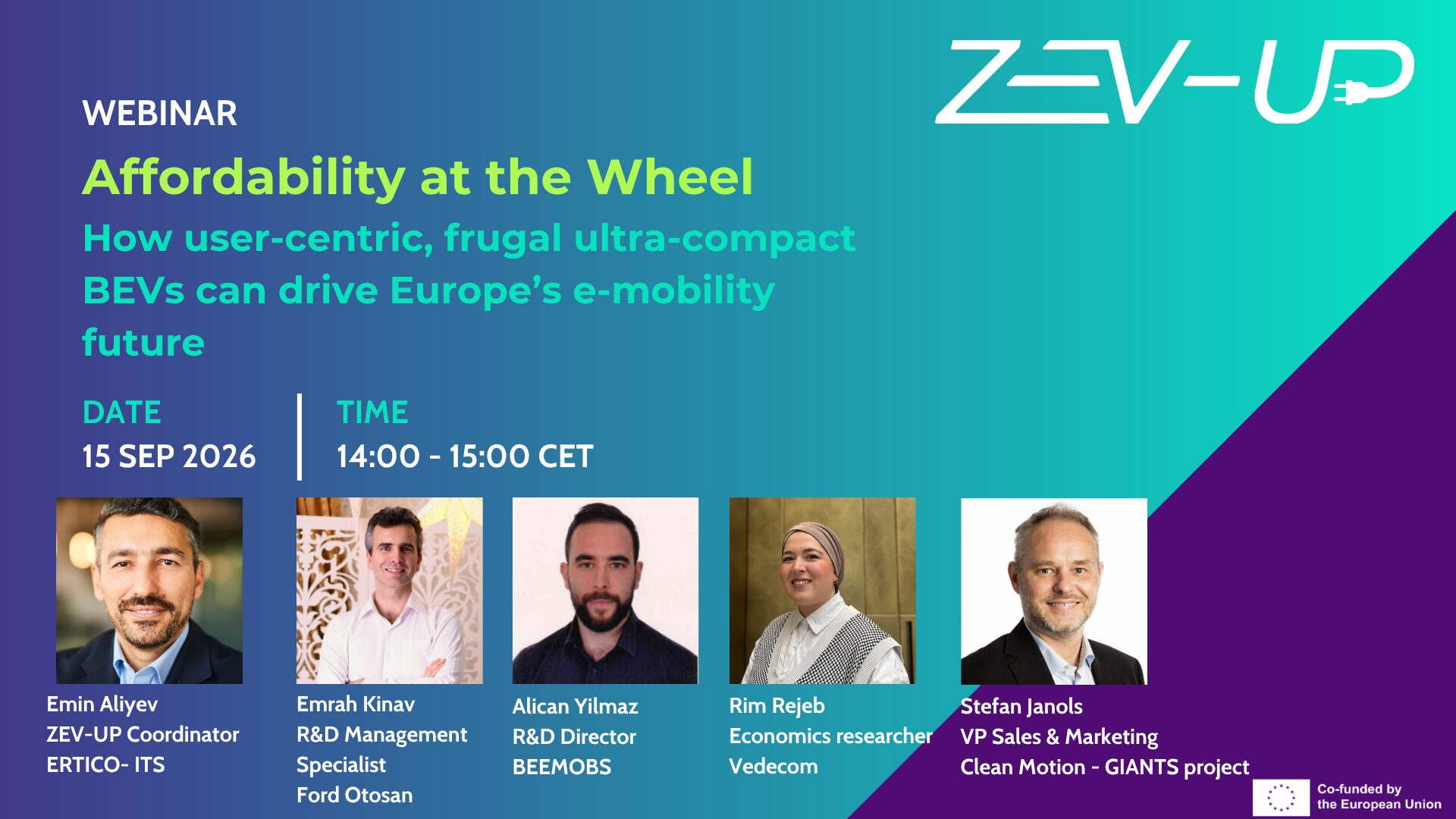
On 15 September 2026, ZEV-UP held its second webinar, “Affordability at the Wheel: How user-centric, frugal ultra-compact BEVs can drive Europe’s e-mobility future”. The webinar brought together project partners as well as sister project GIANTS to explore how smaller, frugal Battery Electric Vehicles (BEVs) can help make urban mobility more affordable and better suited to how people actually travel.
Driving Europe’s e-mobility future
After an introduction by Evan Bernardi (E-Mobility Europe), Gabriele Pesce (E-Mobility Europe) opened the webinar by outlining why ultra-compact vehicles have a role to play in the decarbonisation of transport. Electric vehicles allow the same mobility to be delivered with less energy than combustion vehicles, and many urban journeys are short and made by a single occupant. ZEV-UP rethinks electric vehicle design around actual mobility needs, rather than simply replacing combustion vehicles with electric vehicles of similar size. The project proposes a smaller vehicle which requires fewer materials and less energy to operate, allowing for the use of a smaller battery and a reduced overall footprint.
The ZEV-UP vehicle: an ultra-compact BEV built around user needs
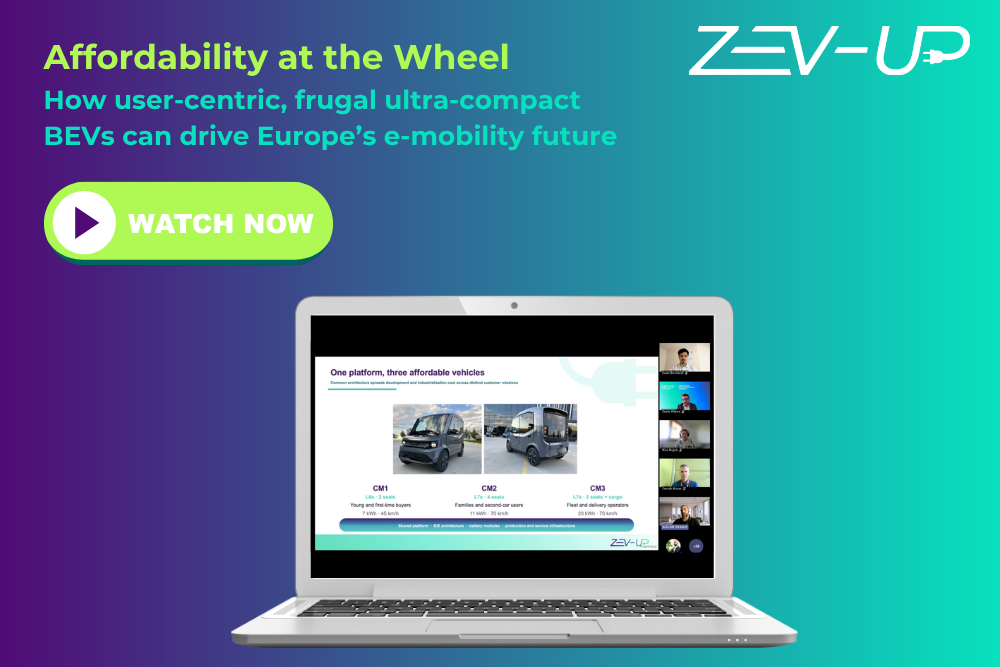
Emin Aliyev (ERTICO – ITS Europe), ZEV-UP Project Coordinator, further presented the project’s aims and the challenges it addresses: the high cost of urban BEVs, congestion, limited parking space, diverse user acceptance, and the sustainability and environmental impact. ZEV-UP is developing an ultra-compact BEV that is user-centric, modular and scalable, intended for both passenger and goods transport. The vehicles include a swappable battery system and is exploring new business models such as Battery as a Service. The ZEV-UP vehicle is available in three variants adapted to different needs: a 2-seater vehicle, a 4-seater, and a commercial variant with 2 seats and a cargo area.
The case for smaller vehicles
Emrah Kinav (Ford Otosan) and Alican Yilmaz (Beemobs) set out the wider market context. With more than half the world’s population living in cities, and that share projected to reach 85% by the end of the century, urban congestion and limited space are growing challenges. While electrification can apply across all vehicle segments, larger electric vehicles do not solve issues of congestion, parking or charging infrastructure demand. Ultra-compact electric vehicles like the ZEV-UP vehicle address several of these challenges at once and are well-suited to everyday mobility use, the majority of trips cover less than 60km.
In this context, affordability means finding a middle ground: cheaper than a standard electric car, but with more range and comfort than micromobility solutions. The most relevant use cases for an affordable electric vehicle were found to be commuting, grocery shopping and errands, following a survey conducted as part of the project. ZEV-UP’s approach to affordability centres on right-sizing: reducing mass, energy demand and component costs, which allow to reduce the overall cost of the vehicle.
What affordability means to users
The consumer perception of affordability was explored by Rim Rejeb (Vedecom). For consumers, affordability extends beyond the purchase price and includes energy, maintenance, depreciation and infrastructure. At the same time, most users don’t use their conventional vehicles’ capabilities to their full potential, rarely using their car’s full range, full power, or all five seats. There is therefore an opportunity to right size vehicles based on actual user needs.
Consumer can however associate lower with lower quality, and while they may accept a smaller car with less range or fewer seats, they are less willing to accept discomfort, unreliable charging or a reduced sense of safety. Affordability needs to reduce cost without reducing perceived value for the consumer. The most successful electric vehicle is not cheapest compact vehicle, but the one that delivers the right value at the right cost.
Insights from the GIANTS project
ZEV-UP’s sister project, GIANTS, was invited to share its experience in developing frugal, sustainable, and zero-emission urban mobility. Stefan Janols (Clean Motion) presented the project’s approach. GIANTS is developing a standardised architecture for L-category vehicles, a shared vehicle control unit (VCU), integrated solar panels, swappable batteries and data collection. The experience from the GIANTS project showed that reducing costs of key components requires shared volumes, and that regulation, including driving licence requirements and parking rules, also shapes how this segment can grow.
The webinar concluded with a Q&A session which drew a range of questions from attendees, allowing for a wider discussion on what stands in the way of adoption. Reducing production costs and shifting consumer perception are both significant challenges, but efforts to make these vehicles more affordable should not come at the expense of the safety, reliability and comfort that users value.
Missed the discussion? Watch a recording of the webinar below.